Ask ten factories what GSM a premium hoodie should be and you will get ten confident answers, usually chosen to match whatever fleece they already have in stock. GSM — grams per square metre — is the single most quoted number in a hoodie spec sheet and the least understood. It tells you a lot about how a hoodie will hang, age and feel, but only if you know which range actually belongs to a premium garment and what the number cannot tell you.
The best GSM for a premium hoodie is 400 GSM for a standard pullover — a workable premium window of 350–450 GSM — with 300–330 GSM for a lighter spring weight and 480–500 GSM reserved for deliberately heavy, structured streetwear silhouettes.1
Everything below assumes one thing: GSM is a measurement, not a marketing word. Once you know the ranges, the reasons behind them, and the four checks that expose a padded spec sheet, you can hold a conversation with a hoodie factory instead of accepting the number you are given.
Start with the number, then understand its edges.
A premium pullover hoodie sits at 400 GSM, with 350–400 GSM reading as a solid mid-weight premium garment and 400–450 GSM as a heavy premium hoodie; anything under 300 GSM is a lightweight sweatshirt rather than a premium piece.2
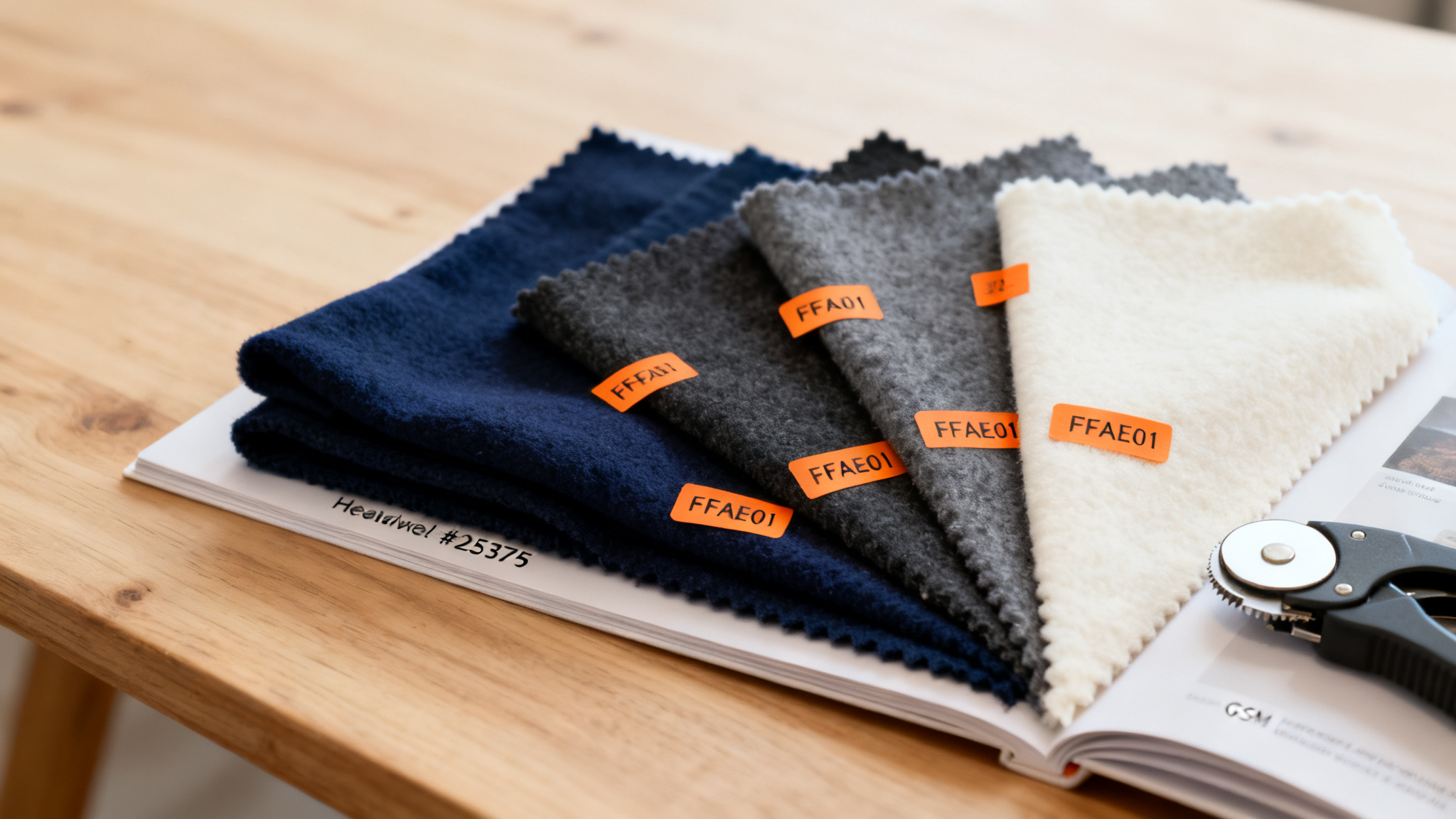
The working ranges most experienced product developers use are consistent. Lightweight hoodies for spring drops run 280–320 GSM. The standard mid-weight premium hoodie that most DTC brands sell as their core product is 350–400 GSM. Heavyweight, boxy, drop-shoulder silhouettes — the ones that photograph well and hold a structured shape — start at 420 GSM and go to 500 GSM. Above 500 GSM you are into novelty territory: the garment weighs nearly a kilo before trims, costs noticeably more to ship, and starts to feel like work to wear.
Because it is the point where structure and comfort stop competing.
At around 400 GSM in loopback French terry, the fabric is dense enough to hold a standing hood, a clean shoulder line and a pocket that does not sag, while staying soft enough and breathable enough to wear as an everyday garment.3

Below roughly 330 GSM the fabric behaves like jersey with a hood attached. The hood collapses forward, the kangaroo pocket pulls the front panel out of shape, and the body develops a soft, slightly limp drape that reads as fast fashion rather than premium. At 400 GSM the same pattern suddenly looks intentional: the hem stands away from the body, sleeves keep a clean cylinder, and the garment keeps its shape after a wash cycle. That structural difference, not the label, is what customers are actually reacting to when they describe a hoodie as feeling expensive. Our breakdown of what makes a garment feel premium covers the same mechanics in knits.
Does higher GSM always mean better quality?
No — and this is where most buying decisions go wrong.
GSM measures mass per square metre, not quality; a 450 GSM hoodie made from short-staple, loosely knitted yarn with a brushed interior can pill, shrink and lose shape faster than a well-built 380 GSM loopback, because yarn quality, knit density, stitch length and finishing matter as much as weight.4
Four things matter alongside the number. First, yarn count and staple length: combed, long-staple cotton knits more evenly and pills less. Second, knit density — two 400 GSM fabrics can differ in how tightly the loops are packed, which is what determines whether the surface stays flat. Third, the interior: brushed fleece feels softer on day one and pills sooner, while loopback French terry is firmer and ages better. Fourth, finishing: a compacted, pre-shrunk fabric may weigh 5% more per square metre after washing than it did on the roll, and that difference is quality, not weight. A factory that only ever quotes GSM is telling you it has one number to sell.
How does GSM change hoodie fit, drape and shrinkage?
Weight is a design decision with visible consequences.
Raising GSM stiffens the fabric, so heavier hoodies drape in flatter planes and read boxier, while lighter hoodies follow the body; heavier knits also shrink less proportionally after compacting but cost more per unit and need wider seam allowances and stronger trims to hold the extra mass.5
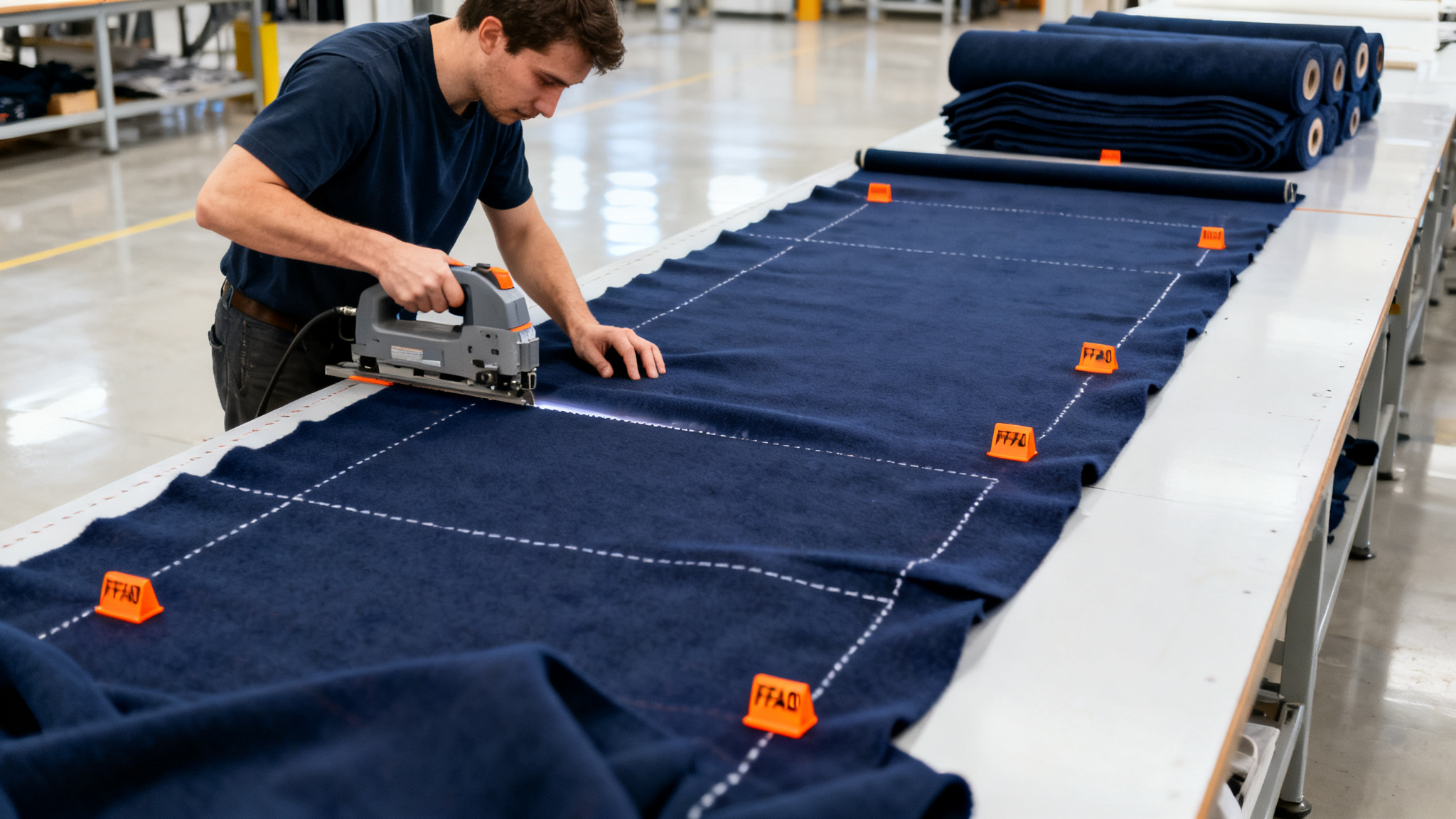
Practically, this is why the same tech pack sewn in 320 GSM and 450 GSM produces two different garments. The heavy version needs a wider neck rib to stop the hood pulling the shoulder seams, a heavier drawcord so it does not disappear into the channel, and a reinforced pocket mouth because the fabric's own weight pulls at the stitching. Shrinkage behaves differently too: a 450 GSM loopback that has been compacted may move 2–3% in the body, while a cheaper 400 GSM fleece that skipped compaction can move 6–8% and take your size grading with it. Ask for shrinkage figures per colourway at sampling, not after bulk.
How do you verify hoodie GSM with a factory?
You verify it the way a lab does — with a cutter, a scale and a tolerance.
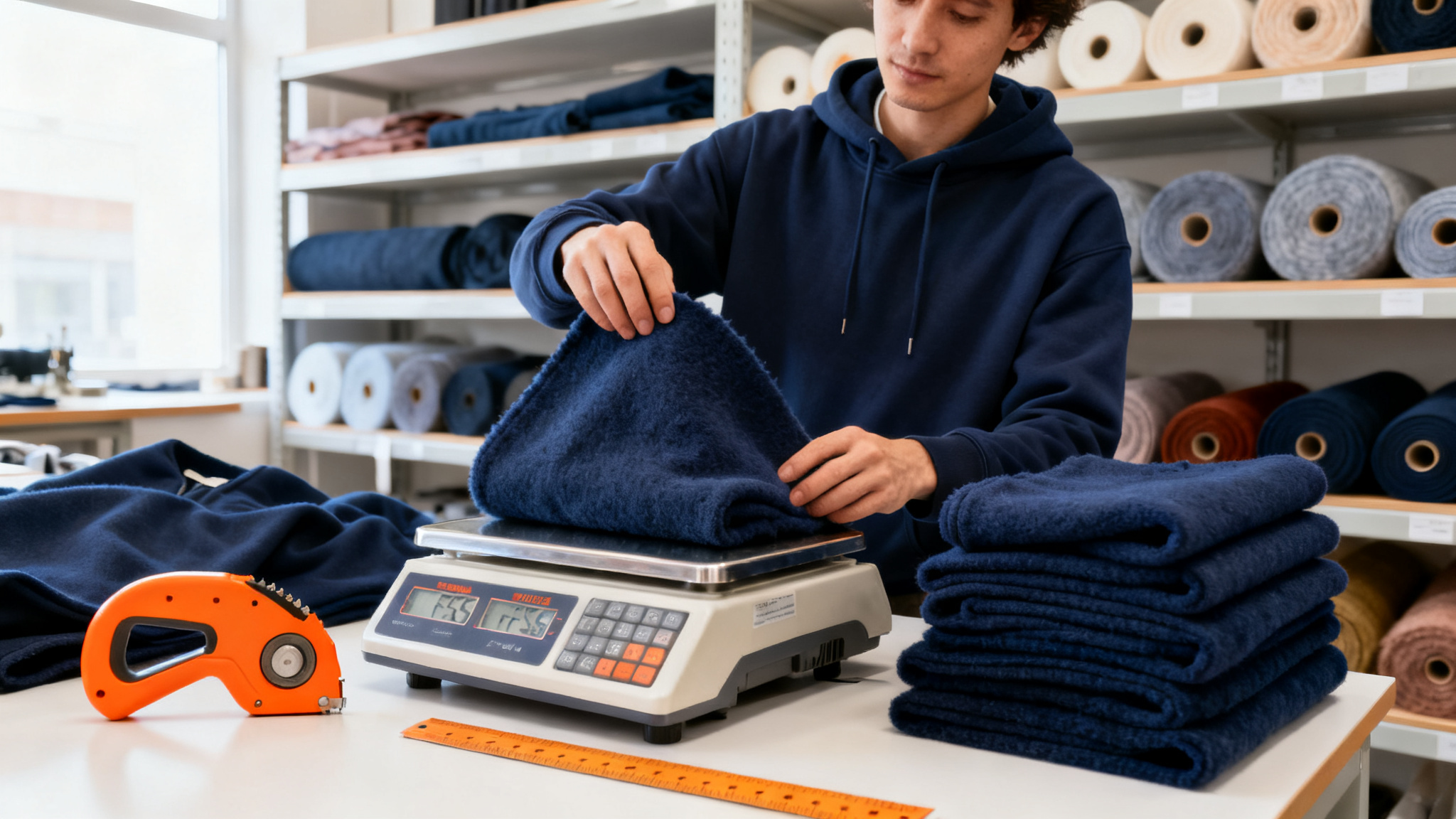
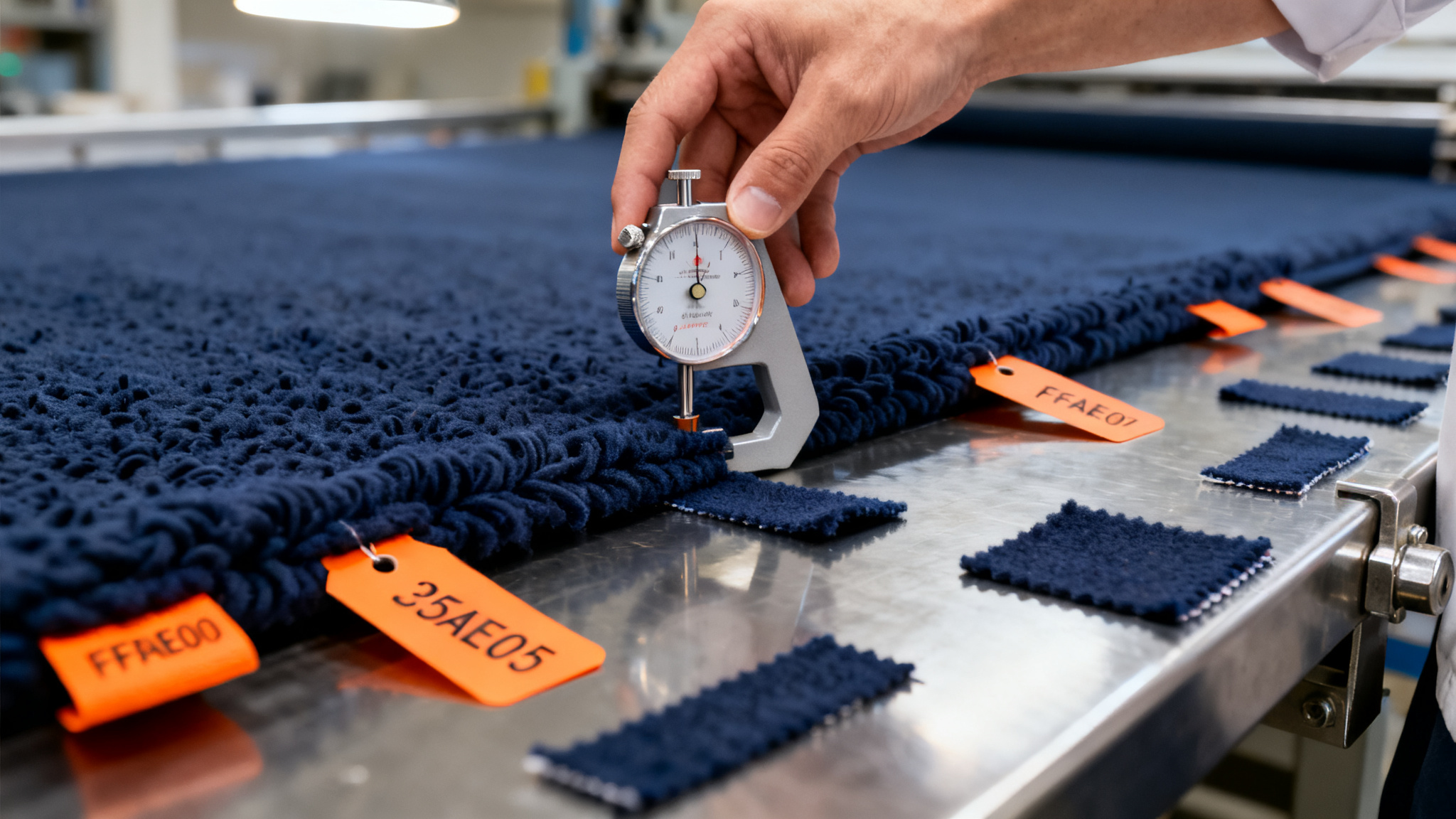
GSM is verified by punching a known-area circle from the fabric with a GSM cutter, weighing it on a calibrated scale, and converting to grams per square metre; a credible factory states the test method, quotes a tolerance of roughly ±5%, and reports the figure per colourway because dyeing and brushing shift the weight.6
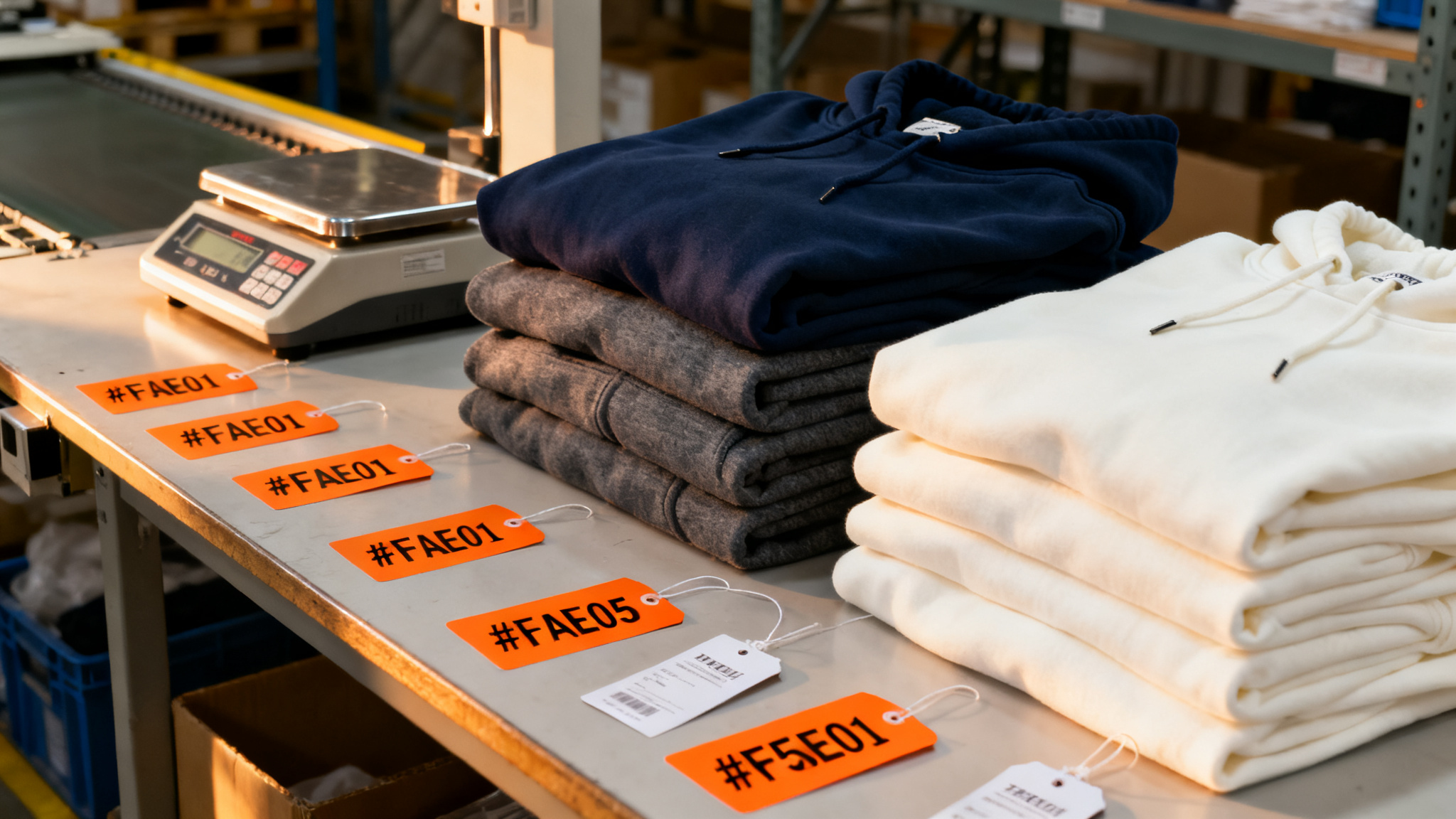
Three requests separate a real spec sheet from a guess. Ask for the GSM test report per colour, since a navy piece-dyed fleece and an off-white one rarely weigh the same. Ask which standard the lab used — the ASTM D3776 fabric weight method is the common reference in export production. And ask what happens if bulk arrives outside tolerance: rework, price adjustment or rejection, in writing. Then do your own check on the pre-production sample with a cheap cutter and scale. If the sample reads 372 GSM when the sheet says 420, you have learned something about the factory that no reference call will tell you. For how weight interacts with fibre choice, see French terry vs fleece.
Conclusion
For a premium hoodie, aim at 400 GSM: 350–400 for a mid-weight core product, 420–480 for a deliberately heavy streetwear silhouette, and never below 300 if the word premium is going on the hangtag. Then treat the number as a claim to be tested, not a fact to be trusted — check yarn, knit density, interior structure and shrinkage alongside it. Adiwe manufactures custom hoodies in loopback French terry from 320 to 480 GSM, with GSM and shrinkage reported per colourway at sampling and low MOQs for first drops — send your tech pack or a reference hoodie and we will confirm the fabric, weight tolerance and price.
"Units of textile measurement", https://en.wikipedia.org/wiki/Units_of_textile_measurement. Reference page defining the textile measurement units used in apparel production, including grams per square metre (GSM) as a measure of fabric mass per unit area. Evidence role: general_support; source type: encyclopedia. Supports: the definition of GSM used throughout this article and the framing of GSM as an area-density measurement rather than a quality grade. Scope note: unit definitions only; contains no recommended weight ranges for specific garments. ↩
"Hoodie", https://en.wikipedia.org/wiki/Hoodie. Overview of the hooded sweatshirt as a garment, covering its construction, typical materials and its role as a heavyweight staple in streetwear. Evidence role: general_support; source type: encyclopedia. Supports: the association between heavyweight knit fabric and the premium hoodie category, and the construction features that depend on fabric weight. Scope note: garment and cultural overview; the specific GSM ranges quoted are typical industry practice, not figures taken from this source. ↩
"French terry", https://en.wikipedia.org/wiki/French_terry. Describes the loopback knit structure of French terry, how it differs from brushed fleece, and how the unbrushed loops affect hand feel, breathability and durability. Evidence role: general_support; source type: encyclopedia. Supports: the explanation of why a 400 GSM loopback hoodie can hold structure while remaining wearable, and why loopback ages better than brushed interiors. Scope note: fabric structure description; does not benchmark drape or shrinkage by weight. ↩
"Polar fleece", https://en.wikipedia.org/wiki/Polar_fleece. Covers synthetic and blended fleece fabrics, their knitted structure, pile formation and how pilling and wear behaviour relate to fibre and construction. Evidence role: general_support; source type: encyclopedia. Supports: the argument that GSM alone does not determine quality, and that yarn, knit density and interior finishing change durability at equal weight. Scope note: focuses on polar fleece rather than cotton loopback, though the pilling and structure reasoning applies to both. ↩
"Clothing industry", https://en.wikipedia.org/wiki/Clothing_industry. Explains how apparel production is organised — design, fabric sourcing, cutting, sewing and finishing — and how fabric properties constrain pattern making and garment construction. Evidence role: general_support; source type: encyclopedia. Supports: the claim that fabric weight drives pattern, seam allowance and trim decisions, and that the same pattern yields different garments in different weights. Scope note: industry-level overview; no fabric-specific shrinkage data. ↩
"Quality control", https://en.wikipedia.org/wiki/Quality_control. Describes quality control as a process of measuring outputs against specified standards with defined tolerances and corrective action. Evidence role: general_support; source type: encyclopedia. Supports: the recommended practice of testing GSM with a cutter and calibrated scale, stating a tolerance, and defining rework or rejection outcomes for out-of-tolerance bulk. Scope note: general QC methodology; the ASTM D3776 reference and ±5% tolerance are apparel industry practice rather than content of this source. ↩
Ready to make this for your brand?
Adiwe manufactures custom T-shirts, hoodies, jackets, pants, shorts and shirts for brands worldwide — from 50 pcs per style and colour, with private labelling, three-stage QC and a physical sample you approve before bulk.
Custom Hoodie ManufacturingCustom T-Shirt Manufacturing