Almost every first-time founder asks the same question in the same way: what does a custom hoodie cost? The honest answer depends on four numbers nobody mentions in a quote — order quantity, fabric weight, decoration and trims — and a fifth that decides everything else: who is actually cutting and sewing the garment. Get those five in the right order and a hoodie price stops being a mystery and becomes a calculation you can check line by line.
Custom hoodie manufacturing costs roughly $15–$22 per unit at 500–1,000 pieces, $20–$28 at 150–300 pieces and $26–$38 at 50–100 pieces for a 350–400 GSM cotton fleece pullover in China, before freight, with samples at $60–$150 each and fabric accounting for 45–60% of the unit cost.1
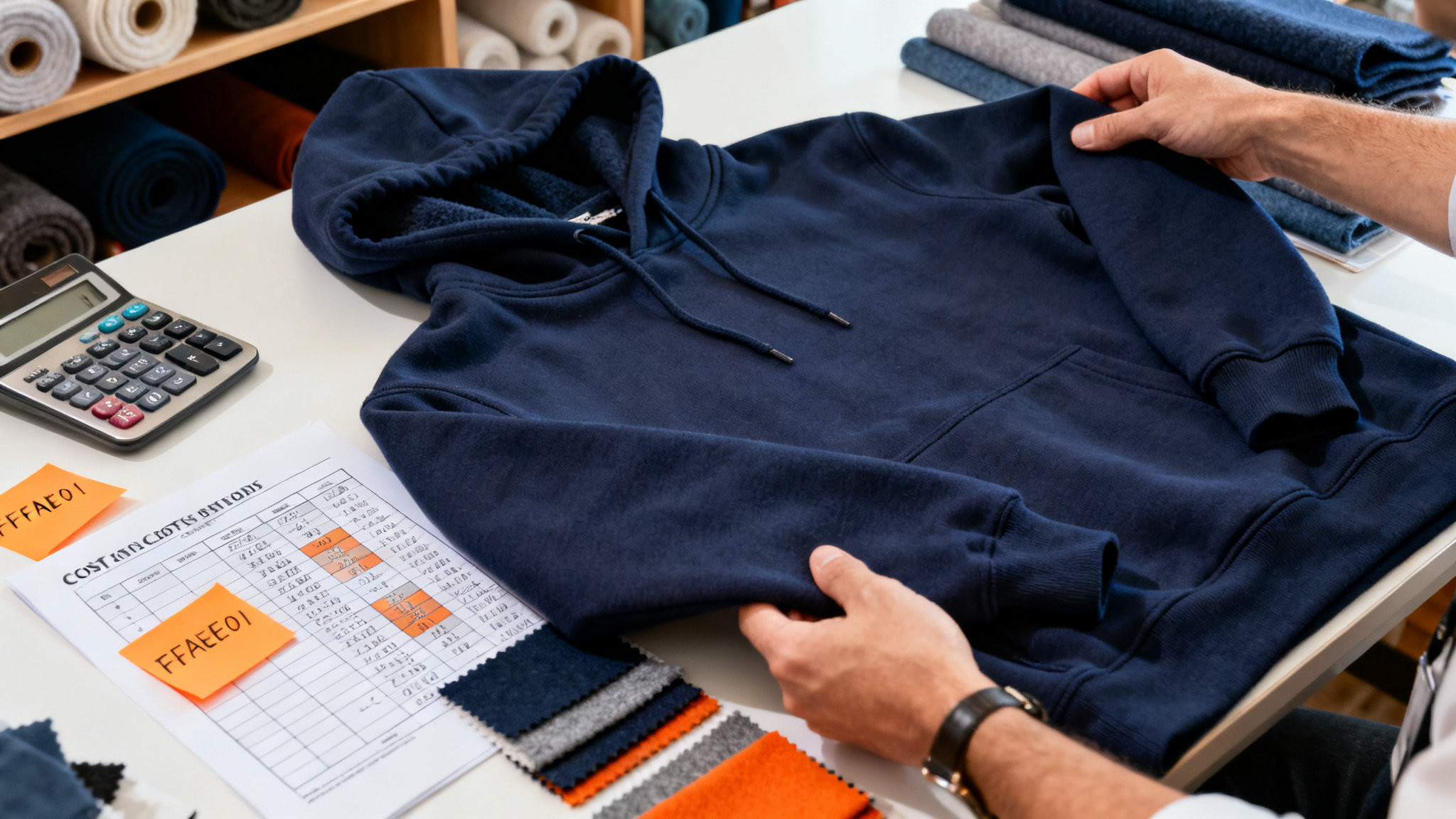
Everything below is built to let you audit a quotation rather than accept one. You will see the real cost bands by quantity, what each component of a hoodie actually costs, why heavyweight and garment-dyed versions move the number so much, and where factories quietly build margin into a spec sheet.
How much does a custom hoodie cost at different order quantities?
Quantity is the single biggest lever, and the curve flattens faster than most people expect.
Hoodie unit cost falls steeply between 50 and 300 pieces and only gently after that: expect $26–$38 at 50–100 pieces, $20–$28 at 150–300, $15–$22 at 500–1,000 and $12–$18 above 2,000, because cutting, sampling, setup and shipping consolidation are fixed costs spread across the run.2
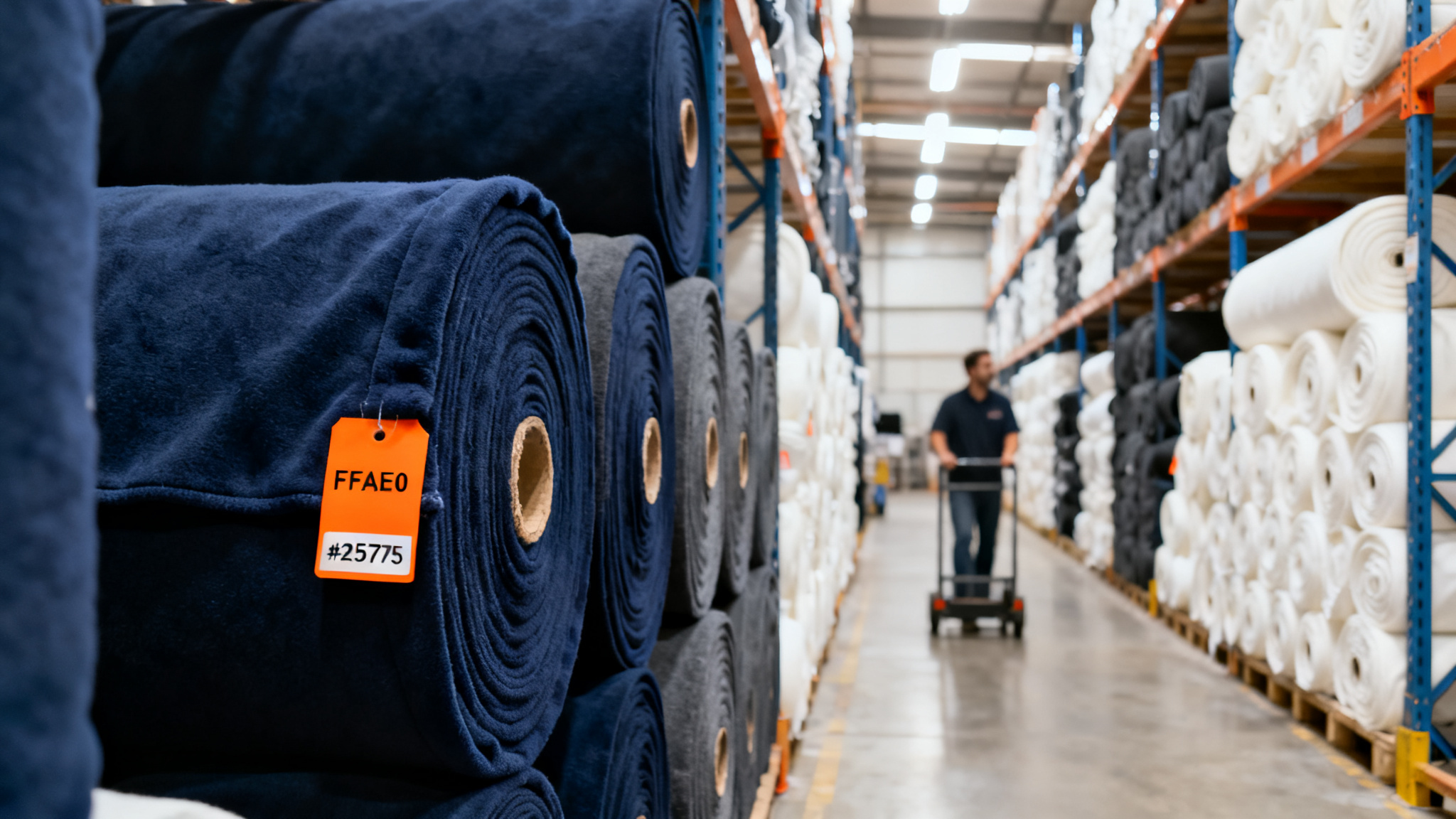
The reason the first hundred pieces are expensive is not greed. A cutting room has to spread and cut a marker whether it produces 60 hoodies or 600, a sample still has to be made and approved, sewing lines need to be set up and balanced, and the factory carries the same admin cost. What changes with volume is how thinly that fixed layer is spread. This is why a 50-piece run at $32 and a 500-piece run at $18 can both be profitable for the same factory, and why a supplier quoting $16 at 100 pieces is either using a lighter fabric than you specified or planning to surprise you later.
What does each part of a custom hoodie actually cost?
Break the garment into components and the price becomes traceable.
In a typical 400 GSM cotton fleece hoodie, fabric accounts for 45–60% of unit cost, cut-and-sew labour 15–25%, trims such as rib, drawcord, eyelets and labels 5–10%, decoration $1.50–$6 depending on method and colours, packaging $0.60–$1.50, with factory overhead and margin taking the remaining 10–20%.3
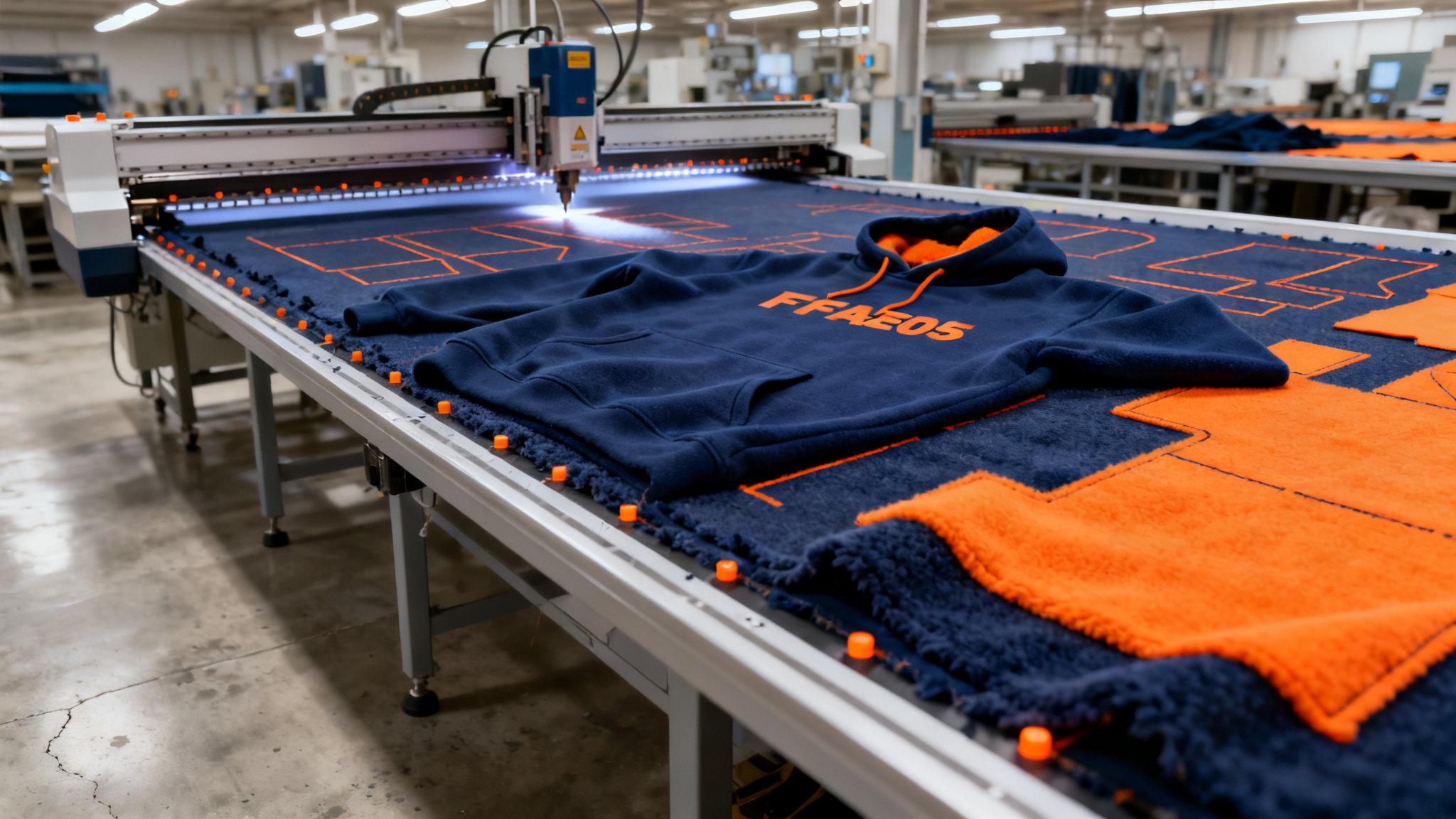
A pullover hoodie uses roughly 1.3–1.6 kg of fleece depending on size and weight, so fabric cost moves with both the GSM and the cotton content. At 400 GSM in combed ring-spun cotton you are typically looking at $8–$13 of fabric per garment; drop to 320 GSM in a cotton-poly blend and that line falls to $5–$8, which is exactly where budget hoodies come from. Labour is the second line to interrogate: a hoodie has more operations than a tee — hood panels, pocket, cuffs, hem rib, drawcord channel — so a factory with weak line balancing will quote higher and still deliver late. Trims are small but visible: a quality YKK-style zip on a full-zip, a heavy flat drawcord, a woven main label and a printed neck label add $1–$2 together and are the easiest place for a supplier to quietly downgrade.
How much does fabric weight and dyeing add to hoodie cost?
Weight and colour are where a cheap quote and a premium garment diverge.
Moving from 320 GSM to 450 GSM fleece adds roughly $3–$5 per hoodie because it consumes 30–40% more yarn per garment, while garment dyeing adds $1.50–$3 and piece dyeing in small lots adds a further premium; combed ring-spun cotton over carded cotton adds $1–$2.4
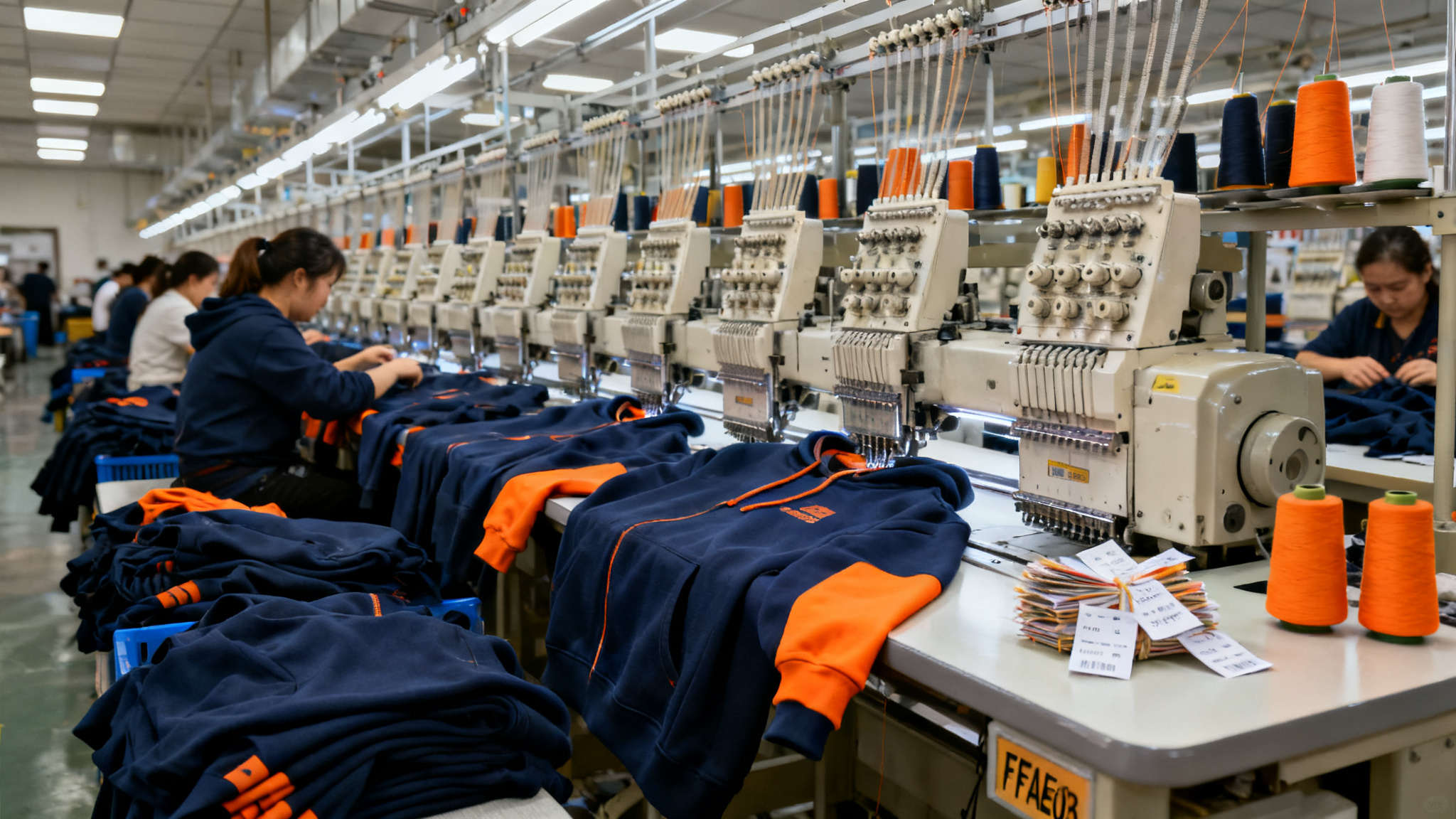
GSM drives yarn consumption almost linearly, which is why heavyweight streetwear hoodies cost more even when everything else is identical. Garment dyeing costs more than piece dyeing because each finished hoodie is dyed individually, giving the washed, slightly uneven look brands want but with more handling and a higher reject rate. Small-lot piece dyeing carries a minimum charge per colour, so a five-colour drop of 60 pieces each is materially more expensive per unit than one colour of 300 — a fact worth knowing before you plan a rainbow first collection. Our guide to choosing hoodie GSM explains which weights are worth paying for.
How much do printing and embroidery add to a custom hoodie?
Decoration is priced per position, per colour, and per size of artwork.
A one-colour screen print on a hoodie typically adds $1.50–$3 per piece, each additional colour $0.50–$1.20, a large back print or all-over puff print $3–$6, and a left-chest embroidery logo $1.50–$4 depending on stitch count, with screen setup charged once per colour per design at roughly $15–$40.5
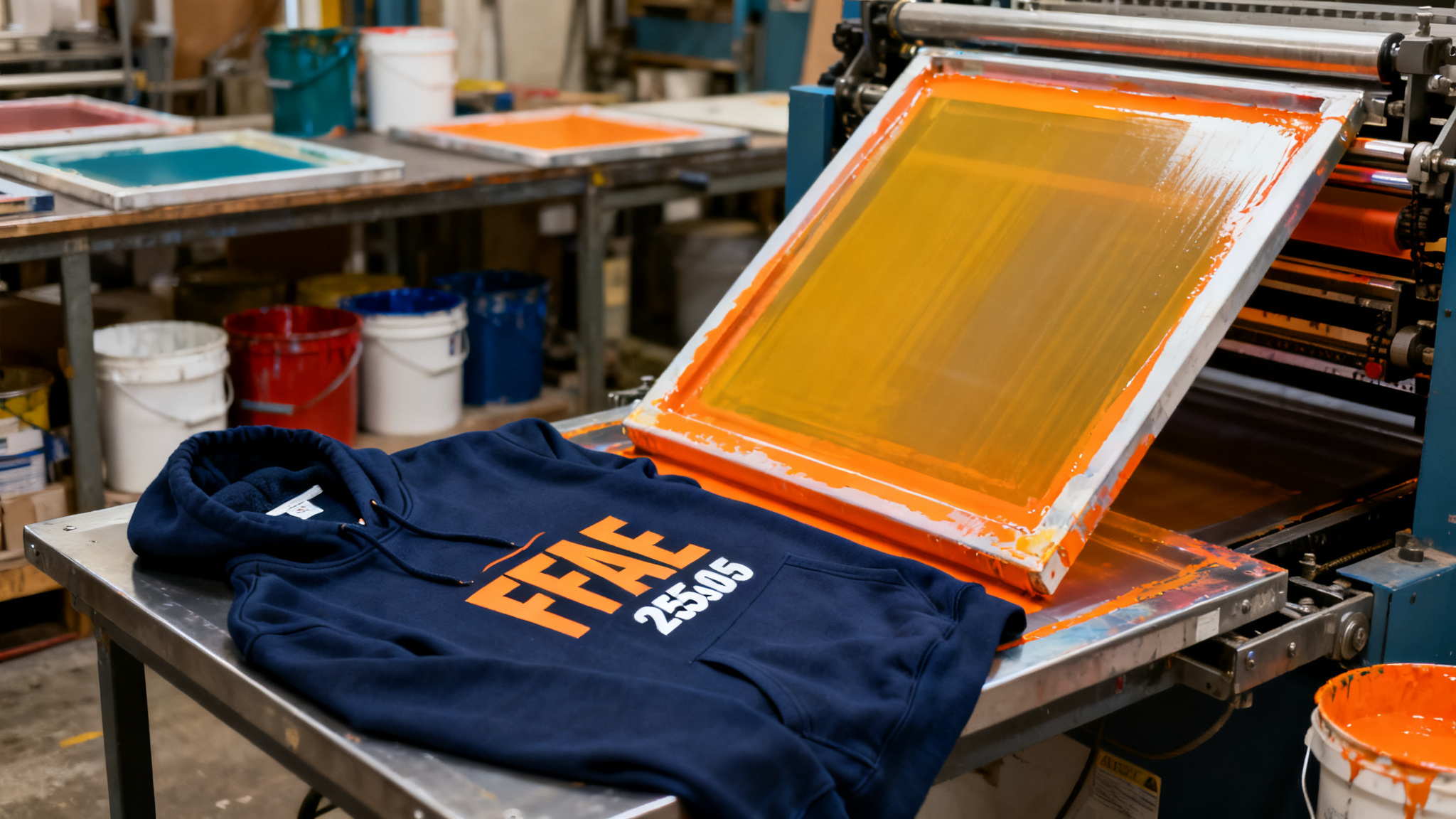
Two economics matter here. Setup costs are one-time and per colour, so a four-colour front print on 50 hoodies carries the same setup burden as on 500 — the setup per unit simply collapses as volume rises. And hoodie fabric is thick and absorbent, which means more ink, longer flash times and a higher risk of a stiff hand feel; a printer who quotes the same price for a tee and a 450 GSM hoodie has not thought about it. If your design has fine gradients or photographic detail, DTG or DTF is often cheaper than a six-colour screen setup at low volume, even though the per-unit rate looks higher.
The quote is not the invoice. Budget the layer around it.
Landed cost adds sampling at $60–$150 per style, lab tests at $50–$200, freight of roughly $1–$2 per hoodie by sea or $5–$9 by air, duty of 8–32% depending on destination and fibre content, plus 3–5% for payment fees — so a $20 hoodie can land at $26–$30 before you have sold one.6
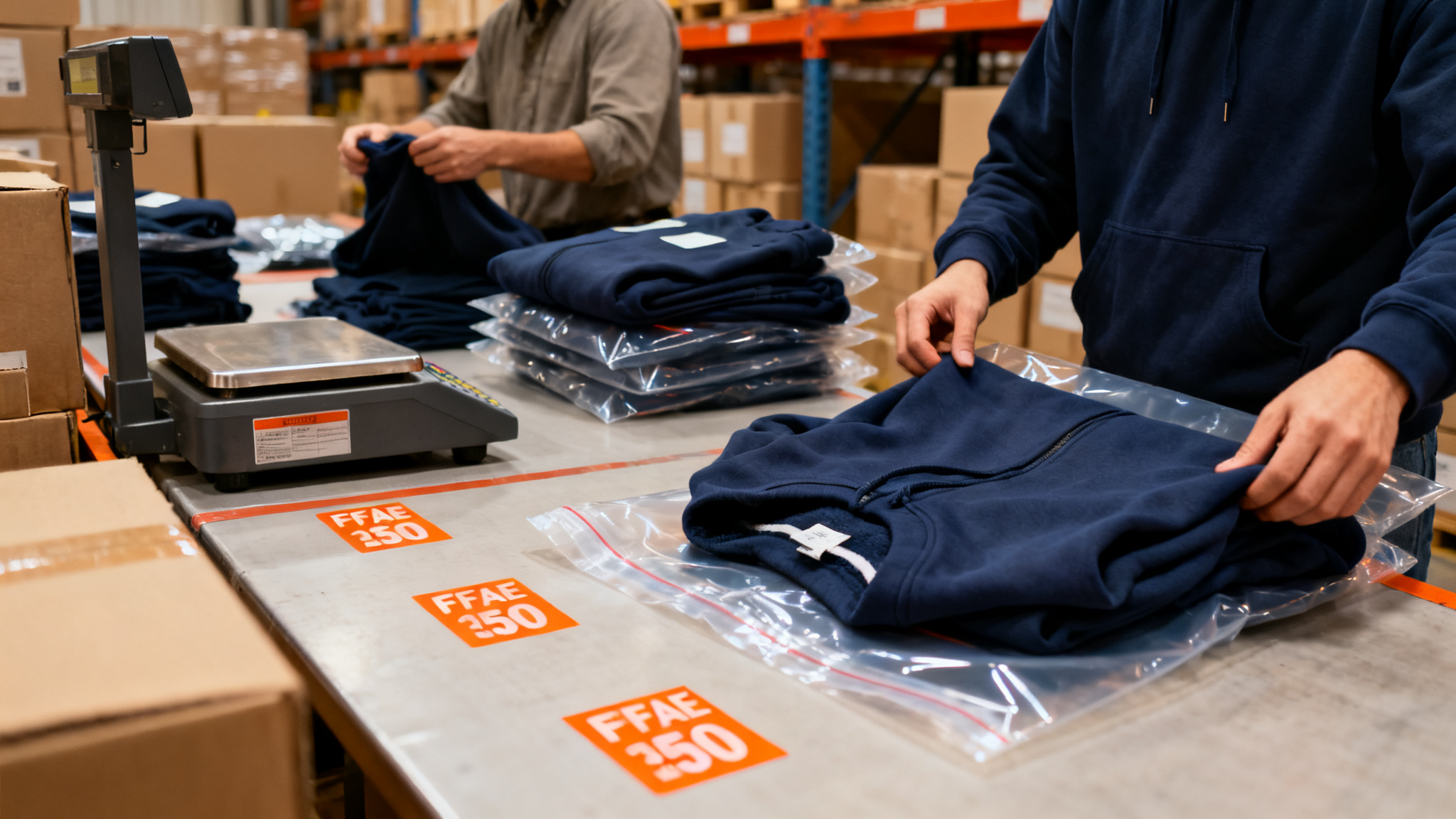
The items founders forget are consistent. Samples are usually credited against the bulk order but still leave your account first. Lab testing — fibre content, colourfastness, shrinkage, sometimes flammability or children's safety — is often required by retailers and always useful for disputes. Freight is quoted per kilo, and heavyweight hoodies are heavy: 500 hoodies at 900 g each is 450 kg before cartons, so the difference between 320 GSM and 450 GSM shows up again on the freight invoice. Duty depends on HS classification and origin rules, and payment terms matter too: a 30% deposit with 70% before shipment is normal, but transferring funds across borders costs 1–3%. Ask for a full landed cost sheet, not a unit price, and compare suppliers on that basis.
Conclusion
Budget $20–$28 per hoodie for a 150–300 piece run in 350–400 GSM cotton fleece, $15–$22 at 500–1,000 pieces, and add $3–$5 for heavyweight 450 GSM, $1.50–$3 for garment dye and $1.50–$6 for decoration. Then add sampling, freight and duty before you set a retail price. Adiwe manufactures custom hoodies at low MOQs with fabric, GSM, decoration and packing costed line by line in the quotation, so you can see exactly where the money goes — send your tech pack or reference hoodie and we will price it against your target quantity.
"Clothing industry", https://en.wikipedia.org/wiki/Clothing_industry. Overview of how the apparel industry is organised, from design and fabric sourcing through cutting, sewing, finishing and distribution, including how production is structured around order volume. Evidence role: general_support; source type: encyclopedia. Supports: the framing of hoodie cost as a function of quantity, fabric, labour and trims rather than a single market price. Scope note: industry-level description; the specific dollar ranges quoted are typical China-based factory pricing, not figures taken from this source. ↩
"Mass production", https://en.wikipedia.org/wiki/Mass_production. Explains the economics of mass production, including how fixed setup costs are distributed across output and why unit cost declines as volume increases. Evidence role: general_support; source type: encyclopedia. Supports: the explanation of why the first 50–100 hoodies cost far more per unit than the same garment at 500–1,000 pieces. Scope note: general manufacturing economics; does not contain apparel-specific price data. ↩
"Textile manufacturing", https://en.wikipedia.org/wiki/Textile_manufacturing. Describes textile production stages from fibre and yarn through fabric formation and finishing, including the material and processing inputs that determine fabric cost. Evidence role: general_support; source type: encyclopedia. Supports: the cost breakdown between fabric, cut-and-sew labour, trims, decoration and packaging in a knitted hoodie. Scope note: technical process overview; the percentage shares are typical apparel costing practice rather than data published by this source. ↩
"Units of textile measurement", https://en.wikipedia.org/wiki/Units_of_textile_measurement. Reference page defining textile measurement units including grams per square metre (GSM), yarn count and fabric weight per unit area. Evidence role: general_support; source type: encyclopedia. Supports: the relationship between higher GSM and greater yarn consumption per garment, which drives the $3–$5 premium for 450 GSM over 320 GSM fleece. Scope note: unit definitions and measurement methods only; no pricing information. ↩
"Screen printing", https://en.wikipedia.org/wiki/Screen_printing. Covers the screen printing process, how a separate screen and setup is required for each colour, and how ink deposit varies with substrate and mesh. Evidence role: general_support; source type: encyclopedia. Supports: the pricing logic of per-colour charges, one-time screen setup fees and higher ink consumption on thick fleece. Scope note: process description; the dollar figures reflect typical factory pricing rather than content of this source. ↩
"Cost of goods sold", https://en.wikipedia.org/wiki/Cost_of_goods_sold. Defines cost of goods sold and explains which costs are carried in inventory and recognised when goods are sold, including freight-in and duties. Evidence role: general_support; source type: encyclopedia. Supports: the argument that landed cost — sampling, testing, freight, duty and payment fees — must be budgeted alongside the factory unit price. Scope note: accounting definition; duty rates and freight figures are illustrative market ranges, not figures from this source. ↩
Ready to make this for your brand?
Adiwe manufactures custom T-shirts, hoodies, jackets, pants, shorts and shirts for brands worldwide — from 50 pcs per style and colour, with private labelling, three-stage QC and a physical sample you approve before bulk.
Custom Hoodie ManufacturingCustom T-Shirt Manufacturing