Every sampling conversation starts with the same question, and it rarely gets a straight answer: three weeks, four weeks, "it depends on the fabric". That vagueness is not evasion. Sampling is a chain of small dependencies — pattern, fabric, trims, sewing, review — and the calendar only holds if every link arrives on time.
A standard clothing sample takes 7–14 working days from an approved tech pack, while a sample that needs pattern making, fabric sourcing and one revision round usually takes 3–5 weeks from brief to approved sample.1

That range covers the ordinary cases: a repeat style in a stock fabric sits at the fast end, a new silhouette in a custom-developed fabric sits at the slow end. Below is how the calendar actually breaks down, where the days disappear, and which parts of it you control. If you are choosing a production partner at the same time, our custom clothing manufacturing overview explains how sampling fits into the wider production timeline.
How long does a clothing sample usually take?
The headline number depends on whether the factory starts from an existing pattern or from a design on paper.
A first sample takes 7–14 working days when the pattern already exists, and 15–25 working days when pattern drafting, grading and a fit test have to happen first.2 Pattern work is skilled labour that happens before any fabric is cut, and it is the step most often left out of a factory's quoted lead time.

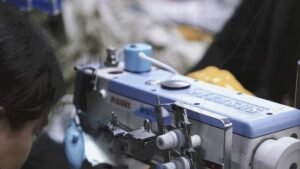
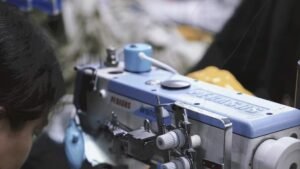
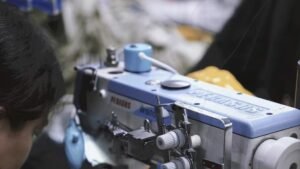
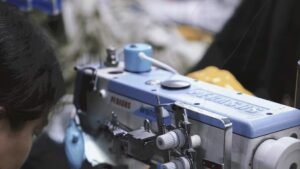
For a simple tee or hoodie from an existing block, three to ten days of sewing is realistic once materials are on the table. The rest of the quoted window is queue time: the sample room books slots, the cutter waits for fabric to be released, and the line waits for the pattern to be checked. On a new development, add pattern drafting, a toile or muslin test, and a grading pass for the size range. That is why two factories can quote the same style at eight days and twenty days and both be telling the truth — they are measuring from different starting points.
What are the stages of the sampling process?
Sampling is not one sample. It is a sequence of approvals, and each one has its own clock.
A full sampling cycle runs through a proto or fit sample, a size set, a salesman sample and a pre-production (PP) sample, with approval at each stage gating the next.3 Skipping a stage does not save the time; it moves the correction into bulk production, where it costs far more.

In practice the fit sample proves the silhouette and construction, the size set proves the grade across the range, and the PP sample proves the exact fabric, trims, color and labels that bulk will use. Each stage needs its own sewing slot and its own review. A brand that treats the fit sample as the only checkpoint usually discovers the label, Pantone or shrinkage problem at the PP stage, which is the most expensive moment to find it. Budget the stages as separate weeks in your launch calendar rather than as one block called "sampling".
What makes clothing sampling take longer than quoted?
Most delays are not caused by sewing. They are caused by things that have to arrive before sewing can start.
Fabric and trim sourcing, custom dyeing or Pantone matching, embroidery digitizing and artwork changes add more days than the garment construction itself, and each one waits in its own queue.4 A stock fabric can be on the cutting table in days; a custom-knit or custom-dyed fabric can take several weeks before it is even releasable for a sample.

Lab dips and strike-offs are the usual culprits: the mill dyes a small batch, the brand approves it against a Pantone chip under the right light, and only then does sample yardage get produced. Trims follow the same pattern — custom drawcords, woven labels, metal hardware and printed tags all have their own lead times, and one missing item holds the whole sample. Factory capacity matters too: sample rooms are small teams, and they fill up before peak seasons and around Chinese New Year, when the calendar loses one to three weeks regardless of what was promised.
How much time does each revision add?
Revisions are normal. Unplanned, scattered revisions are what damage the calendar.
One revision round typically adds 5–10 working days, because the sample re-enters pattern correction, cutting, sewing and a new review slot.5 The sewing itself may take two days; the re-booking is what costs the week.

The fix is procedural rather than technical. Collect every comment from fit, print, trim and merchandising into one marked-up sample with a single owner, and send it once. Comments that trickle in over five days turn one revision into three. Photograph the sample on a mannequin with a tape measure visible, reference the measurement chart rather than adjectives, and state clearly whether a point is a must-fix or a nice-to-have. Two revision rounds is a normal budget for a new style; if you are on the fourth, the problem is usually the brief, not the factory.
How can you shorten sampling without lowering quality?
Speed in sampling comes from removing waiting, not from rushing the sewing.
The brands that sample fastest arrive with a complete tech pack, choose in-stock fabric and trims, and approve in one consolidated round; the factories that compress a cycle to under two weeks rely on standard components and tight control of their own supply chain.6

A tech pack with flat sketches, measurements, construction notes, fabric references and print placement removes the back-and-forth that eats the first week. Booking fabric before the sample is approved, or choosing a stock quality you can re-order, removes the longest external wait. Limiting the first drop to one or two colorways and one fabric per style keeps the sample room moving. And if timing is critical, say so at the quoting stage: factories can often hold a slot for a confirmed date, but they cannot create one after the fact. For a first collection, plan four to six weeks from brief to approved sample and you will rarely be late.
Conclusion
Sampling takes 7–14 working days in the simple case and three to five weeks once pattern making, sourcing and a revision are included. The number is driven less by sewing speed than by how complete your brief is and how quickly fabric, trims and approvals arrive. Build the sample calendar backwards from your launch date, keep one revision round in reserve, and confirm the PP sample before bulk cutting. If you want a realistic sampling timeline for a specific style and quantity, send us your tech pack and we will quote the stages separately, or start with our custom t-shirt manufacturing page for tees and basics.
"Clothing industry", https://en.wikipedia.org/wiki/Clothing_industry. Overview of the apparel value chain, from design and pattern making through sample making to bulk manufacturing and distribution. Evidence role: general_support; source type: encyclopedia. Supports: the framing that sampling sits between design work and bulk production, and that its length varies with how much development precedes it. Scope note: industry-level description; it does not publish per-stage day counts, which differ by product, factory and season. ↩
"Pattern (sewing)", https://en.wikipedia.org/wiki/Pattern_(sewing). Describes pattern drafting, grading and the use of test garments (toiles) to check fit before final fabric is cut. Evidence role: general_support; source type: encyclopedia. Supports: pattern making and fit testing are separate, skilled steps that must be completed before a sample can be sewn. Scope note: craft-level explanation of pattern making; commercial turnaround times are not covered. ↩
"Quality control", https://en.wikipedia.org/wiki/Quality_control. Covers inspection, approval gates and pre-production checks as part of a controlled manufacturing process. Evidence role: general_support; source type: encyclopedia. Supports: the idea that each sample stage acts as an approval gate before the next stage begins, including pre-production sign-off before bulk. Scope note: generic quality-management theory; garment-specific AQL sampling and PP sample conventions come from industry practice rather than this source. ↩
"Lead time", https://en.wikipedia.org/wiki/Lead_time. Defines lead time and cumulative lead time in supply chains, including order, queue and processing time. Evidence role: general_support; source type: encyclopedia. Supports: total sampling time is the sum of sequential waits (materials, queue, processing) rather than sewing time alone. Scope note: general operations concept; it does not provide apparel-specific durations for dyeing, trims or sample rooms. ↩
"New product development", https://en.wikipedia.org/wiki/New_product_development. Describes staged development with iterative prototyping, review and rework loops. Evidence role: general_support; source type: encyclopedia. Supports: each review-and-rework cycle restarts part of the process, so a revision round costs a full cycle rather than only the changed step. Scope note: general product-development framework; the 5–10 working day figure is an apparel-industry rule of thumb, not a figure stated in the source. ↩
"Fast fashion", https://en.wikipedia.org/wiki/Fast_fashion. Describes compressed design-to-retail cycles and the vertical integration and standard components that make them possible. Evidence role: general_support; source type: encyclopedia. Supports: very short sampling and production cycles depend on standard components and tight control of the supply chain, not on faster sewing alone. Scope note: describes large vertically integrated retailers; small brands working through third-party factories should expect longer cycles. ↩
Ready to make this for your brand?
Adiwe manufactures custom T-shirts, hoodies, jackets, pants, shorts and shirts for brands worldwide — from 100 pcs per style and colour, with private labelling, three-stage QC and a physical sample you approve before bulk.
Custom Hoodie ManufacturingCustom T-Shirt Manufacturing